
Vacuum Forming vs. Injection Molding: How to Choose the Right Process for Your Parts
This article compares Vacuum Forming and Injection Molding across production volume, cost, lead time, design flexibility, and quality to help you choose the right plastic manufacturing process.
Published 2026-04-15
What's inside
- What is Vacuum Forming?
- Advantages of Vacuum Forming
- Limitations of Vacuum Forming
- What is Injection Molding?
- Advantages of Injection Molding
- Limitations of Injection Molding
- Comparing Key Factors
- Practical Applications and Industry Use Cases
- Which Manufacturing Process Is Right for Your Project and When?
- Final Thoughts
About this resource
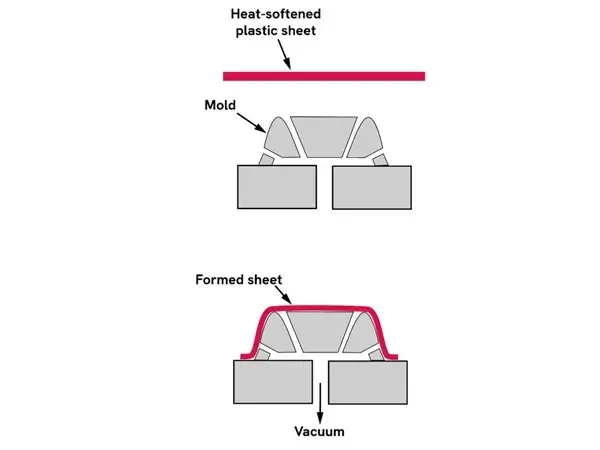
Choosing between vacuum forming and injection molding depends on your project's volume, budget, timeline, and quality requirements. Vacuum forming heats a thermoplastic sheet and draws it over a mold with vacuum pressure, making it ideal for prototypes, packaging, trays, automotive components, and display items. It offers low tooling costs, fast turnaround, flexible design iterations, and compatibility with materials such as ABS, PETG, polycarbonate, and PVC.
Injection molding injects molten plastic into a steel or aluminum mold under high pressure. It excels at mass-producing durable, high-precision parts with tight tolerances and consistent quality, making it suitable for consumer goods, automotive parts, medical devices, and industrial components.
Key Comparison
| Factor | Vacuum Forming | Injection Molding |
|---|---|---|
| Production Volume | Best for low to medium volumes | Suitable for high-volume production |
| Lead Time | Rapid setup; parts within days | Longer lead times; weeks or months for molds |
| Initial Cost | Low; minimal tooling costs, mainly silicone molds | High; expensive metal molds required |
| Surface Finish & Detail | Excellent surface finish with high detail | Very high quality and precision |
| Material Options | ABS, PETG, PVC, and specialty materials | Nylon, polycarbonate, ABS, and engineering plastics |
| Design Flexibility | High; easy to modify during prototyping | Limited; modifications require new molds |
| Part Durability | Less durable; ideal for visual models | Highly durable; functional, load-bearing parts |
| Tolerance & Accuracy | Good but less precise | Extremely precise with tight tolerances |
| Tooling & Maintenance | Silicone molds are inexpensive but wear quickly | Steel or aluminum molds last thousands of cycles |
| Cost per Part | Higher at larger volumes | Decreases significantly with volume |
| Speed of Production | Very fast for small batches | Slow setup but very fast for large quantities |
| Environmental Impact | Lower energy consumption; less waste | Higher energy use; more waste at large volumes |
When to Choose
Choose vacuum forming for quick prototypes, small to medium batches, frequent design changes, and cost-sensitive limited runs where high strength is not critical.
Choose injection molding for large quantities of uniform, durable parts requiring high accuracy, tight tolerances, and long-term cost savings.
A common strategy is to start with vacuum forming for early prototypes and switch to injection molding for high-volume manufacturing.