
Understanding Composite Materials
A comprehensive guide to composite materials, covering their history, structure, properties, types, benefits, industrial applications, and future trends.
Published 2026-05-12
Key findings
What's inside
- What is a Composite Material?
- Major Properties of Composite Materials
- Types of Composite Materials
- What are the Benefits of Composites?
- Key Applications Across Industries
- The Future of Composite Materials
- Conclusion
Who it's for
- Engineers and product designers
- Aerospace and automotive professionals
- Construction and marine industry specialists
- Researchers and students in materials science
About this resource
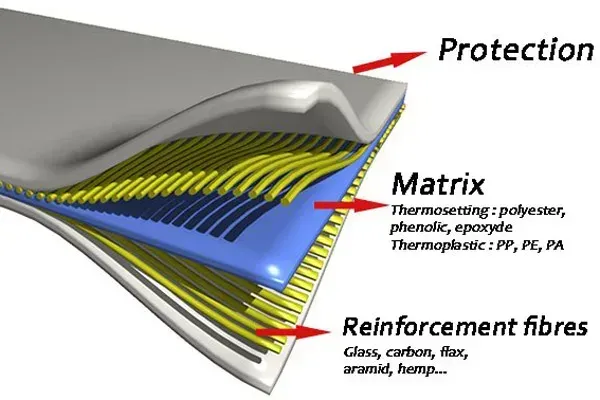
Composite materials combine two or more constituent materials with different physical or chemical properties to create a material that outperforms its individual components. The matrix surrounds and protects the reinforcement, while the reinforcement provides strength, stiffness, and toughness.
This guide explains the major properties of composites, including their high strength-to-weight ratio, corrosion resistance, tailorable properties, design flexibility, fatigue resistance, and thermal and electrical insulation. It also covers the main types of composite materials:
- Fiber-reinforced composites (GFRP, CFRP, AFRP)
- Particulate composites
- Structural composites
- Hybrid composites
Learn about the benefits of composites, such as lightweight design, enhanced mechanical properties, corrosion resistance, and energy efficiency, plus key applications across aerospace, automotive, construction, marine, sports, electronics, medical devices, and renewable energy.
The guide concludes with emerging trends including thermoplastic composites, nanocomposites, sustainable bio-based composites, and out-of-autoclave manufacturing.