
Post Processing for Direct Metal Laser Melting (DMLM)
A practical guide to the main post-processing steps for Direct Metal Laser Melting (DMLM), covering loose powder removal, thermal treatment, support removal and surface finishing.
Published 2024-07-17
Key findings
What's inside
- Loose Powder Removal
- Thermal Processing
- Stress Relief Treatment
- Hot Isostatic Pressing (HIP)
- Gas Nitriding
- Supports Removal
- Metal Surface Treatment
- Subtractive Finishing Process
- Additive Finishing Process
Who it's for
- Engineers and designers specifying DMLM metal 3D printed parts
- Teams planning build orientation and post-processing workflows
- Buyers evaluating cost and lead-time implications of finishing operations
About this resource
Direct Metal Laser Melting (DMLM) metal 3D printed parts require a structured post-processing workflow after the build is complete. This guide explains the standard stages from loose powder removal through thermal treatment, support removal and final surface finishing.
Loose Powder Removal
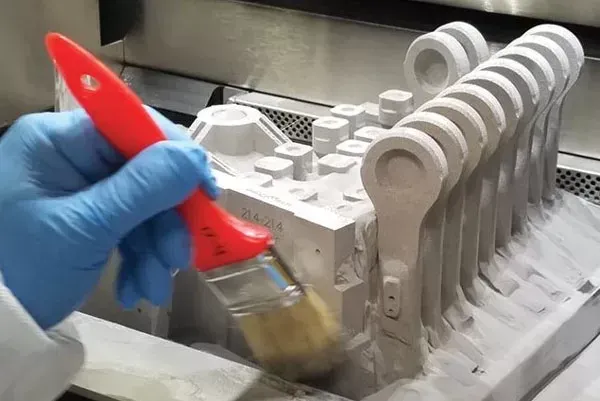
Unfused powder remaining after the build is removed with brushes or hand tools. Powder trapped in internal features can be cleared using compressed air or ultrasonic cleaning equipment.
Thermal Processing
Residual stress caused by rapid heating and cooling is addressed through stress relief treatment, which reduces the risk of warping after the part is removed from the build plate.
Hot Isostatic Pressing (HIP) applies heat and high pressure to improve mechanical properties and increase density by eliminating internal and surface porosity, since as-built parts typically reach only about 99.5% density.
Gas Nitriding is a surface hardening process performed around 520°C using dissociated ammonia as a nitrogen source. It improves wear resistance and surface hardness.
Supports Removal
Support removal is a challenging and time-consuming step, so optimizing part orientation during software preparation is critical to minimize support generation. After thermal processing, parts and supports are separated from the build plate using pliers, hammers, cutting or grinding tools. For large contact areas, wire EDM or a handsaw is used.
Metal Surface Treatment
As-built surface roughness varies with powder particle size, layer thickness, build orientation and support locations, with down-facing and supported areas generally being rougher.
Subtractive finishing uses mechanical or chemo-mechanical actions such as media blasting, grinding, sanding, bead blasting, shot peening, machining, tumbling, polishing and electro-polishing. Media blasting cleans residue powder, while machining delivers high-precision finishes when extra material allowance, typically 0.5 mm, is added before printing.
Additive finishing processes such as anodizing, electroplating, painting and Physical Vapor Deposition (PVD) add protective and decorative layers to metal 3D printed parts.