← Knowledge Base
MJF vs SLS: Which 3D Printing Method Is Right for Your Parts?
A comprehensive comparison of MJF and SLS to help you choose the right 3D printing process for quality, functionality, and cost.
Published 2026-09-15
What's inside
- Understanding MJF and SLS Technologies
- Comparison of Key Features
- Advantages of MJF
- Advantages of SLS
- Applications and Use Cases
- Limitations to Consider
- Which Process Is Right for You?
- Conclusion
Who it's for
- Engineers selecting an industrial 3D printing process
- Manufacturers needing high-volume production or fast turnaround
- Designers of functional prototypes and durable end-use parts
- Teams producing large or complex polymer components
About this resource
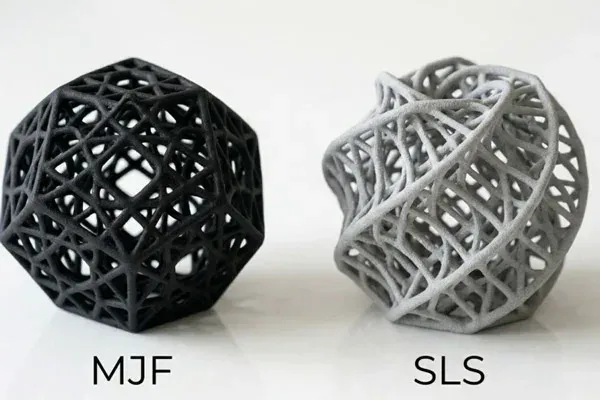
Multi Jet Fusion (MJF) and Selective Laser Sintering (SLS) are two leading powder-bed fusion technologies for producing complex, durable polymer parts. This guide explains how each process works, compares their materials, surface finish, accuracy, strength, speed, build volume, post-processing, and cost, and outlines the strengths and limitations of both.
- MJF advantages: fast batch production, smooth surfaces, tight tolerances, and cost-effective high-volume runs.
- SLS advantages: broad material selection, excellent mechanical properties, design flexibility, and larger build volumes.
- Applications: MJF suits consumer products, automotive and medical devices; SLS fits functional prototypes, aerospace, automotive and industrial end-use parts.
Use the comparison to decide whether MJF or SLS aligns best with your volume, timeline, part size, material, finish, and budget requirements.
MJF vs SLS: Which 3D Printing Method Is Right for Your Parts?Guide · FreeDownload PDF